


Are Blaze Grills Worth It? Where They're Made and How They Hold Up

Blaze is the grill we build into more outdoor kitchens than any other, so you should read a dealer saying it is worth it with some scepticism. The useful version of this article is the one that explains why it is worth it for most people, where it is not, and what you are actually buying when you buy one. That is what follows.
Where Blaze grills are made
Blaze Outdoor Products is an American company based in Baton Rouge, Louisiana. It designs its grills in the United States and has them manufactured to its own specifications overseas. That is how the line reaches commercial-grade 304 stainless construction and cast stainless burners at a position in the market well below the brands that hand-finish in California.
It is worth being plain about this because the question gets asked a lot. If a grill built in the United States matters to your decision, Blaze is not that grill, and Fire Magic or Lynx is where to look. If what matters is what the grill is made of and how it is backed, read on.
How a Blaze is built
The things that decide whether a grill survives Las Vegas are not features. They are materials.
- 304 stainless steel body and hood. The grade that resists corrosion. Cheaper grills use 430 stainless, which is magnetic, cheaper, and blooms surface rust after two or three summers here.
- Cast stainless burners. Heavy, slow to corrode and the component that fails first on a tube-burner grill. Blaze's are the single best argument for the brand.
- Heavy cooking grids and flame tamers. The grids hold heat for a sear; the tamers spread it and catch drippings. Both are replaceable, which is how a grill lasts twenty years rather than ten.
- Welded construction. Real welded seams rather than folded and riveted panels.
Blaze backs its grills with a long warranty — the terms vary by component and change from time to time, so rather than quote them here we go through the current coverage on the specific grill you are considering and put it in writing. The useful point: Blaze's warranty reputation is a large part of why dealers like us specify it.
Which Blaze to buy
Blaze makes four built-in families, and the differences are real.
Prelude and LTE
The entry into the line. Same 304 body and cast burners as the rest, without interior lighting or the heavier control knobs. For a grill going into an island on a budget, this is where most people start, and very few regret it.
LTE+
Adds backlit knobs and interior lights. Cosmetic until you cook at seven in the evening in November.
LTE PRO
The step up in cooking hardware — heavier grids, more output — in 32-inch four-burner and 40-inch five-burner, with a matching griddle and power burner. The family we recommend for anyone who cooks for a crowd regularly.
LUX
The top of the built-in range, in 34 and 44 inches. Heavier throughout. The Blaze to compare directly against the premium brands.
The full Blaze range also includes the components — doors, drawers, refrigeration, side and power burners, griddles, a kamado and an outdoor oven — which is the quiet reason to choose it for a whole kitchen: everything matches because it all came from one manufacturer.
How Blaze holds up in Las Vegas
The failure mode for cheap grills here is not dramatic. It is surface rust on 430 stainless after a couple of summers, then igniters, then heat deflectors warping through. Blaze's 304 body removes the first of those, which is the one you cannot fix. The igniters and deflectors on any grill are consumables; Blaze's are available and replaceable.
What still matters regardless of brand: a cover, because UV destroys knobs and gaskets faster than heat does; cleaning the grease tray before it carbonises; and expecting to replace burners and flame tamers once in the grill's life. A Blaze that gets that care outlasts a grill that cost twice as much and got none.
Blaze against the alternatives
Blaze vs Weber
Different categories. A Weber is a freestanding grill designed to be good out of the box; a Blaze is a built-in designed to go into an island with matching components. At comparable sizes the Blaze has heavier construction and a far deeper component line; the Weber has a longer freestanding heritage. We have written up Weber alternatives in detail for anyone making exactly this comparison.
Blaze vs Napoleon
Napoleon's strength is freestanding; its built-in range is three grills. Blaze's is all built-in with the components to finish a kitchen. Our Blaze vs Napoleon comparison goes through it line by line.
Blaze vs Summerset
The closest comparison and the one worth seeing in person. Both are 304 stainless mid-market built-ins with full component lines. Our Summerset review is the honest version of that side of it.
Blaze vs Lynx and Twin Eagles
Here the difference is obvious in a minute on the showroom floor: hand-dressed welds, heavier gauge steel, and a finish that justifies the position. If the kitchen is the centrepiece of the yard and the budget allows, the step up is real. If it is not, a Blaze in a finished island beats a premium grill in an unfinished one.
What Blaze grills cost
We do not publish prices, for a reason worth explaining. A built-in grill is a fraction of what an outdoor kitchen costs; the island, the gas run, the electrical, the countertop and the permits are the rest, and the grill's price in isolation tells you almost nothing about the project. What drives the cost of a Blaze is the family (Prelude through LUX), the width, and whether it goes on a cart or into an island. We quote the grill and the kitchen together so the number means something.
Who should buy something else
- You want an American-made grill. Fire Magic or Lynx.
- You want wood smoke. A pellet grill is a different appliance — see Traeger or Memphis.
- You want the best built-in available and the budget covers it. Lynx or Twin Eagles.
- You want a freestanding grill for a patio, not an island. Napoleon's Prestige line, or a Blaze on a cart.
What to check before you buy any built-in
Whichever way you lean, these are the things that distinguish grills in Blaze's bracket, and most spec sheets bury them:
- Stainless grade, stated as a number. "Stainless steel" without one usually means 430. Blaze states 304.
- Burner material. Cast stainless outlasts tube burners. Count matters less than material.
- Grate weight. Pick one up. Light grates are the clearest sign of corner-cutting.
- Cutout dimensions. Blaze built-ins run from roughly 23 to 42 inches of cutout width across the families, and none of them is a generic 36. The island is built to the grill, so choose the grill first.
- Whether the matching components exist. Doors, drawers and refrigeration in the same finish, or a kitchen assembled from three manufacturers that never quite line up.
The verdict
For most Las Vegas outdoor kitchens, a Blaze is worth it: 304 stainless, cast burners, a complete component line and a strong warranty, at a position that leaves money for the island. It is not the best grill made and does not claim to be. It is the grill that makes a finished outdoor kitchen possible on a sensible budget, and in our experience a finished kitchen with a Blaze gets used far more than an unfinished one with something more expensive.
Every family is on the floor at our S Fort Apache showroom next to the brands it competes with. See the Blaze range, or start with how a complete outdoor kitchen build works.
See It In Person Before You Buy
Every grill we write about is on our showroom floor on Fort Apache. Come compare them side by side, or ask us anything about pricing and availability.
Building it in? See our custom outdoor kitchens in Las Vegas
Related Posts
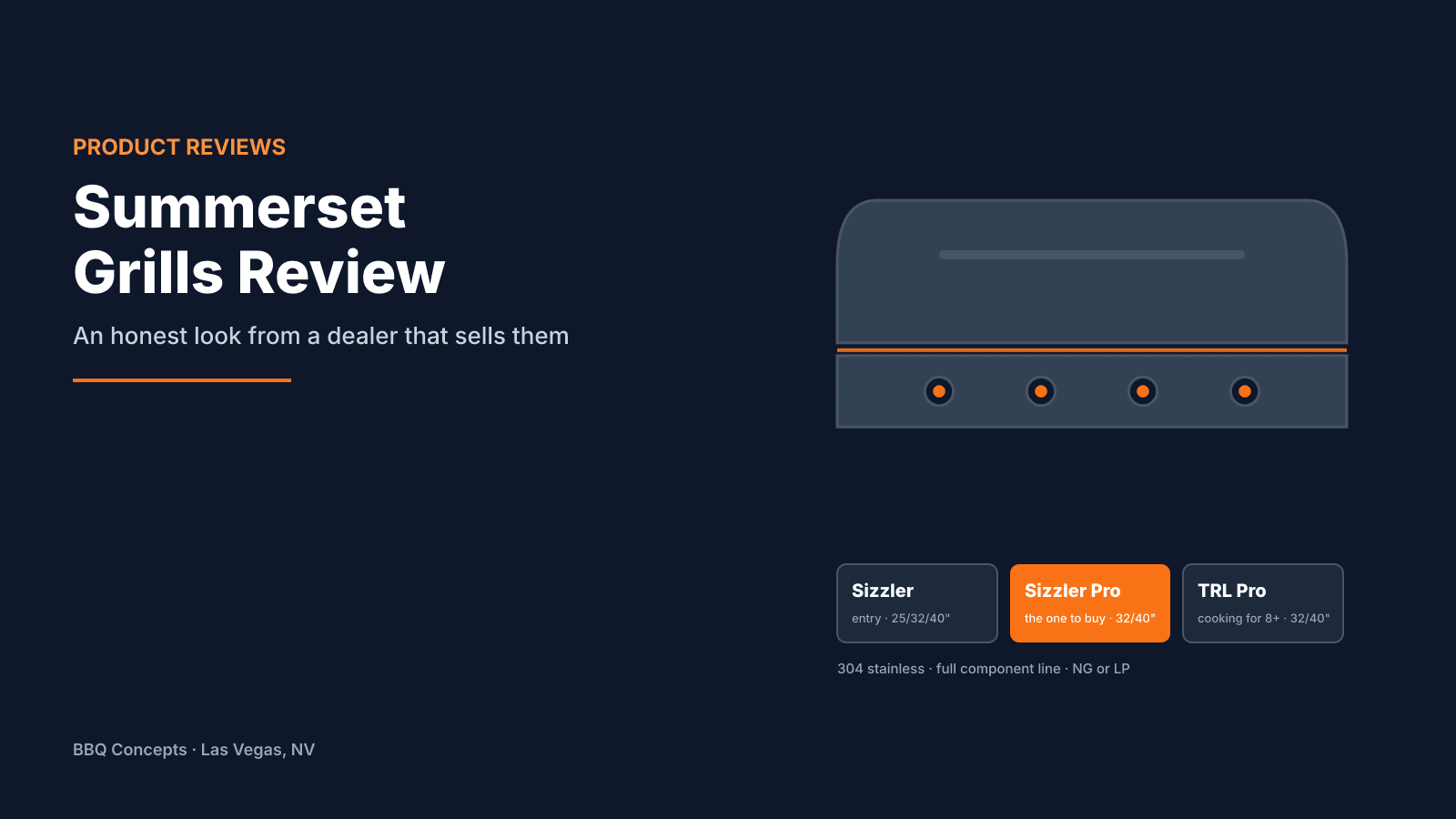
Summerset Grills Review: An Honest Look From a Dealer
We sell Summerset, so take this with the appropriate salt — but here is where the brand genuinely sits, which line is worth the step up, and who should buy something else.
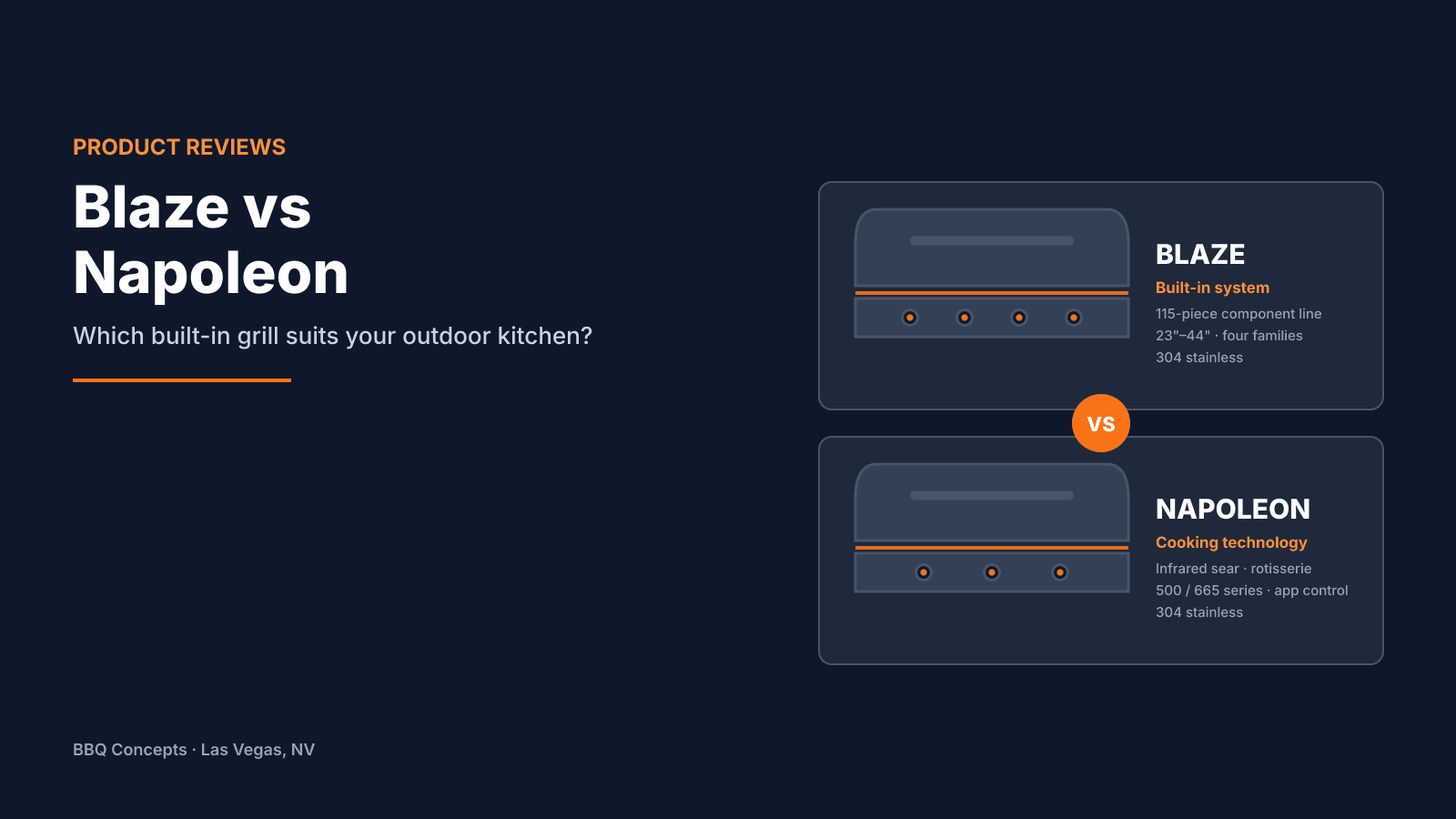
Blaze vs Napoleon: Which Grill Suits Your Outdoor Kitchen?
Blaze and Napoleon get cross-shopped constantly, but they are built for different installations. A straight comparison from a showroom that carries both.
Weber Grill Alternatives: How Blaze, Napoleon & Lynx Compare
We don't carry Weber — on purpose. Here's an honest comparison of the built-in grill brands we do carry, and which one fits which kind of griller.